
Walmart Connect is a powerful foundation for any brand serious about growing on Walmart.com. But the brands pulling ahead in 2026 aren't stopping there. Walmart's Search Engine Marketing (SEM) program is the natural next layer, a way to extend your reach beyond Walmart.com and capture high-intent shoppers on Google before they've even landed on the platform. Think of it as the cherry on top of your Walmart Connect strategy.
Walmart's SEM program lets sellers run Google Shopping ads that drive external traffic directly to their Walmart product listings. It's been available for over a year. Many sellers haven't fully activated it yet, not because it doesn't work, but because they haven't had the right tooling to run it smarter and see the full picture.
This guide covers everything you need to know about the program: how it works, why it strengthens your existing Walmart strategy, what's held brands back from scaling it, and how to run it more effectively.
What Is Walmart's Google SEM Program?
Walmart's Search Engine Marketing program is a paid advertising tool that enables sellers to create Google Shopping ads for their Walmart products. When a shopper searches for a relevant product on Google, your ad can appear in the sponsored shopping section at the top of the results page, with your product image, price, and a direct link to your Walmart listing.
A few things that make this program distinct:
- It uses a cost-per-click (CPC) model, you only pay when a shopper actually clicks your ad
- Walmart's proprietary AI automatically sets and adjusts bids based on performance data
- Your offer is shown whether or not you're winning the Buy Box unlike Sponsored Search ads on Walmart.com, which require Buy Box ownership
- Shoppers click through directly to your Walmart.com listing, where they can complete the purchase
The program runs through Seller Center, and setup is relatively straightforward once you understand the mechanics.
How Google SEM Fits Into Your Walmart Advertising Strategy
IIt's worth being clear about how SEM complements the other advertising tools available to Walmart sellers, because each one serves a distinct role in your overall strategy.
Google SEM vs. Sponsored Search: Sponsored Search ads appear to shoppers who are already browsing on Walmart.com, a high-value audience already in buying mode. Google SEM extends that reach by capturing shoppers on Google before they've even landed on the platform. That's an earlier stage of the purchase journey, and a meaningful opportunity to introduce your brand when intent is highest.
Additionally, Sponsored Search requires Buy Box ownership to show your ad. Google SEM does not, making it accessible even for sellers in competitive categories where Buy Box control fluctuates.
Google SEM vs. SEO: SEM is paid, your ads are labeled "Sponsored" and appear prominently at the top of results. SEO is organic, it's the work of building listing quality, keyword relevance, and conversion rate so your products rank naturally over time. The two work hand in hand. As we'll explain below, running SEM can actively accelerate your organic performance on Walmart.
%202.59.32%E2%80%AFp.m..png)
Why Google SEM Makes Your Walmart Strategy Stronger
Walmart is already one of the most aggressive buyers of Google Shopping real estate in the US. The Google SEM program lets you extend that presence by investing specifically in your own SKUs, so your brand controls which items show up in those prime placements, building on everything your Walmart Connect campaigns are already doing on-platform.
Running your own Google SEM campaigns means you control which of your SKUs get promoted. You guarantee your items appear for the searches that matter most to your brand, your product terms, your category terms, your branded keywords , rather than leaving that to chance.
Beyond placement control, there's a compounding benefit that makes Google SEM especially valuable as part of a broader Walmart strategy.
External traffic drives organic rank on Walmart.
Walmart's search algorithm rewards items that generate strong conversion rates. When qualified, high-intent shoppers from Google land on your Walmart listing and purchase, that sends a quality signal to Walmart's algorithm that your listing is worth surfacing. Over time, sellers who run consistent external traffic see meaningful lift in their organic rank, which amplifies everything your on-platform investment is already building.
This is why Google SEM isn't just an ad channel. It's a rank-building strategy that makes your entire Walmart presence stronger.
How Dashna Makes Google SEM Smarter
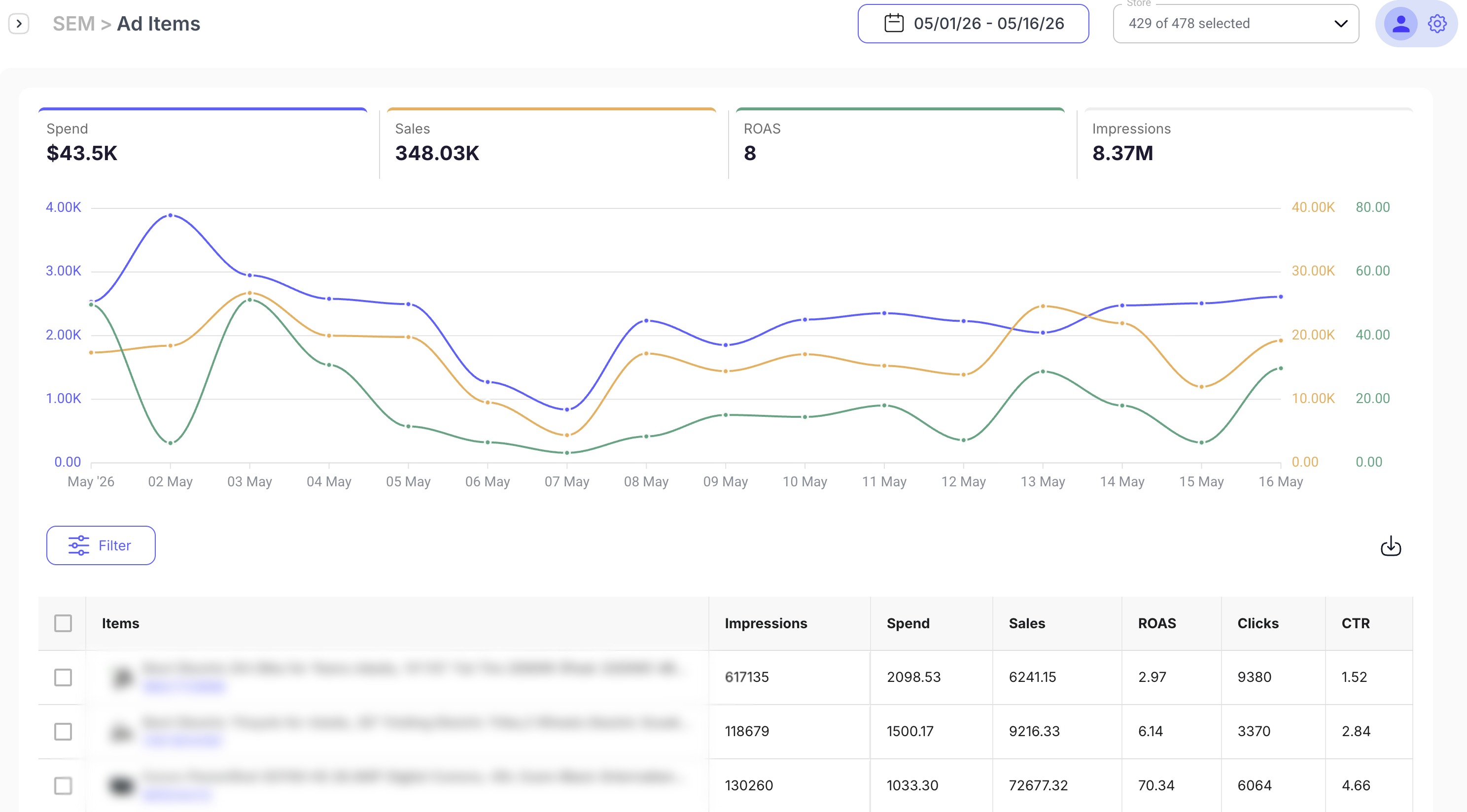
Dashna is SellCord's proprietary software built specifically for Walmart sellers. With our newest capability, Google SEM management built directly into Dashna, it's now the only platform where you can run, optimize, and measure Google Shopping campaigns alongside your existing Walmart retail media strategy, all in one place.
What that means in practice:
Campaign management inside Dashna. Set up, manage, and optimize your Google SEM campaigns in the same dashboard where you're already running your Walmart Connect strategy. No platform switching, no fragmented reporting.
Keyword rank tracking. See how your Google campaigns are influencing your organic position on Walmart. Connect the dots between external traffic and on-platform rank movement, at the keyword level.
Organic lift visibility. Understand which SKUs are gaining search rank as a result of your Google spend, not just direct sales. That compounding effect is often where the real value lives, and now you can actually see it.
Budget pacing tools. One of the most common issues with Google SEM is budget concentration , spend burns through in the first week and goes dark for the rest of the month. Dashna's pacing tools distribute spend intelligently across the full campaign period so your ads stay active when it matters.
Unified view of your Walmart advertising. With Walmart Connect and Google SEM in one dashboard, you can make smarter decisions about where your ad dollars will drive the highest return, and optimize across channels rather than managing them in silos.
The roadmap goes further. We're building toward cross-channel budget allocation tools that make intelligent recommendations about where to shift spend between Google and Walmart Connect based on real efficiency data. One dashboard. Full visibility. Smarter decisions.
Best Practices for Google SEM on Walmart
Whether you're managing campaigns inside Dashna or getting started natively in Seller Center, these practices will meaningfully improve your results.
1. Start with your highest-converting SKUs Google Shopping ads are powered by your product data, title, image, price, and description. Items with strong listing quality and proven conversion rates will see better Google ad performance too. Start there, then expand to your broader catalog.
2. Don't sleep on new launches and seasonal moments Google SEM is particularly effective for new product launches that need early velocity, and for seasonal windows where search demand spikes. Create dedicated campaigns for these moments with specific SKU sets and appropriately elevated budgets.
3. Give campaigns time New campaigns can take two to three weeks to build momentum. If you set up a campaign and see limited activity in the first week, don't pull the plug. Let Walmart's bidding algorithm gather data and optimize. Patience in the early phase consistently leads to stronger performance.
4. Monitor ROAS, but also watch rank True performance measurement for Google SEM goes beyond direct ROAS. Track what happens to your organic rank on Walmart for the SKUs you're running SEM against. That downstream lift is often where the real value compounds over time.
5. Run SEM and Walmart Connect together , they work better as a pair Google SEM is additive. Brands that run both channels in parallel consistently outperform those treating them as either/or. Walmart Connect owns the on-platform shopper. Google SEM captures demand upstream, before the shopper has even chosen a retailer. Together they cover the full funnel, and the organic rank benefits of external traffic make your Walmart Connect investment work harder too.
Is Google SEM the Right Next Step for Your Brand?
Google SEM is a strong next step if you're already running Walmart Connect and want to extend your reach, accelerate rank, or capture new demand beyond Walmart.com. It's particularly well-suited if:
- You want to amplify your existing Walmart Connect performance with an additional traffic layer
- You have new products that need launch velocity and early sales history
- Your organic rank on key terms has stalled and you need an external signal to accelerate it
- You're in a competitive category where Buy Box ownership fluctuates and you want ad exposure regardless
- You're an Amazon-first brand expanding to Walmart and want to build momentum fast
For brands serious about building a complete Walmart presence, Google SEM is increasingly the next logical investment after Walmart Connect is performing well.
The Bottom Line
Google SEM takes a strong Walmart Connect strategy and makes it a full-funnel one. The program is established, the channel is high-intent, and the compounding effect on organic rank makes the investment more valuable than direct ROAS alone.
What's been missing is the tooling to run it smarter, and that's exactly what Dashna now provides.
This is a game-changer you shouldn't miss out on. If you're ready to add Google SEM to your Walmart strategy and want to see how Dashna can help you run it with keyword rank tracking, organic lift visibility, and smarter budget pacing, book a call with the Sellcord team.
We'll walk through exactly what this looks like for your catalog.
Sellcord is a full-stack Walmart omnichannel agency and the team behind Dashna, a retail media platform built specifically for Walmart sellers. We help mid-market and enterprise brands scale on Walmart.com through listing optimization, retail media management, and in-store activation.