Most Walmart marketplace seller teams can tell you their ROAS. Far fewer can tell you whether that ROAS reflects sales their advertising actually caused, or sales that would have happened anyway. Walmart incrementality is the discipline that answers that question, and it is quickly becoming the standard every serious walmart seller is expected to understand. This guide breaks down what incrementality actually means on Walmart, where the data lives across walmart seller center, Walmart Connect, and Scintilla, and how the relevancy flywheel connects your organic and paid strategy into one measurable system.
What Is Walmart Incrementality?
Walmart incrementality is the measurement of growth that would not have happened without your investment. Instead of crediting every sale that touches an ad, incrementality isolates the sales an advertiser actually caused, separating them from purchases a customer was already going to make regardless of exposure. A supplier evaluating incrementality asks a simple question: if I stopped my ad spend today, what would happen to my sales tomorrow? The answer separates genuine demand creation from money that is simply being moved around. This distinction matters more on walmart.com than on most platforms, because Walmart's own first-party data can trace a shopper from initial exposure all the way through an in-store or online purchase. Much of this ties directly back to relevancy, the same factor that determines who wins the walmart buy box, since a listing that converts well earns both organic rank and incremental reach at the same time.
Why Does Incrementality Matter for Walmart Marketplace Sellers?
Ignoring incrementality has real consequences. A campaign can post a strong ROAS while mostly reaching loyal repeat buyers or people already searching your brand name by name, which means the spend is efficient but not growing your business. Left unchecked, this leads to three specific problems: budget gets locked into keywords that were already winning instead of funding new demand, teams lose the ability to explain to leadership why ad spend increased without sales increasing at the same rate, and brands miss early warning signs that their conversion funnel, not their media plan, is the actual bottleneck. Understanding incrementality gives a walmart marketplace seller a clearer read on which dollars are building the business and which are just renting a position that was already secure.
How to Build Walmart Incrementality
Incrementality on Walmart is built, not bought. It comes from a specific sequence: establishing item-level relevancy, laddering into keyword-level relevancy, and using that momentum to fund expansion into new terms. Here is the process step by step.
1. Establish your item-level relevancy first
Item-level relevancy is Walmart's assessment of whether your product, as a whole, is worth surfacing at all. The number one driver of item-level relevancy is conversion rate, not content score. A listing with a 95 percent content quality score can still fail to convert, because content quality and relevancy are not the same signal. Before targeting any keyword, confirm your images, pricing, shipping speed, and backend categorization are fully in place, since Walmart is constantly checking whether your product converts wherever it is shown. Our walmart listing quality score guide breaks down each compliance component this step depends on.
%25208.52.32%25E2%2580%25AFa.m..png)
2. Avoid starting on your broadest keyword
It is tempting to target the single biggest keyword in your category first. This often backfires. A niche product, like an aluminum-free deodorant for women, competing directly on the broad term "deodorant" is immediately fighting for a term that half the audience is not shopping for, which suppresses conversion rate from the very first impression. A weak conversion rate on one keyword damages your item-level relevancy everywhere else it appears.
3. Win your high-intent, narrow keyword first
Instead, start with the most specific keyword your product genuinely serves, such as "women's aluminum-free deodorant." High-intent, narrow terms convert better because the shopper searching them already knows exactly what they want. Winning here builds real conversion data that Walmart's algorithm associates with your item.
%25208.54.09%25E2%2580%25AFa.m..png)
4. Ladder up to broader keywords
Once you have won a narrow term, use that conversion strength to expand into moderately broader terms, such as "women's deodorant." This is the laddering technique: each win compounds into the next level up, because your listing now arrives at a wider keyword with proven conversion history behind it rather than a cold start.
5. Let organic wins fund new investment
As you win organically on your top terms, you can pull back ad spend from those terms and reinvest in new areas, since previously-won keywords continue generating sales with less paid support. That reinvestment cycle, term won organically, budget freed up, budget redeployed into new demand, is the literal definition of incremental growth. This same principle underpins the tradeoffs covered in our walmart 1P vs 3P guide, since data access and reinvestment options differ meaningfully between selling models.
6. Track the full funnel, not just sales
Layer your cost per click, organic rank, and sponsored rank against your impression share, click share, and add-to-cart share. If organic rank is climbing while cost per click is falling, you are winning efficiently. If impression share is high but click share is low, the problem is discoverability of intent, often the main image or price. If click share is high but add-to-cart share lags, the listing itself, not the ad, is losing the sale.
Where Walmart Incrementality Data Actually Lives
One of the more overlooked realities of Walmart measurement is that the richest incrementality signals do not require a paid Scintilla subscription. The table below breaks down what each source gives you.
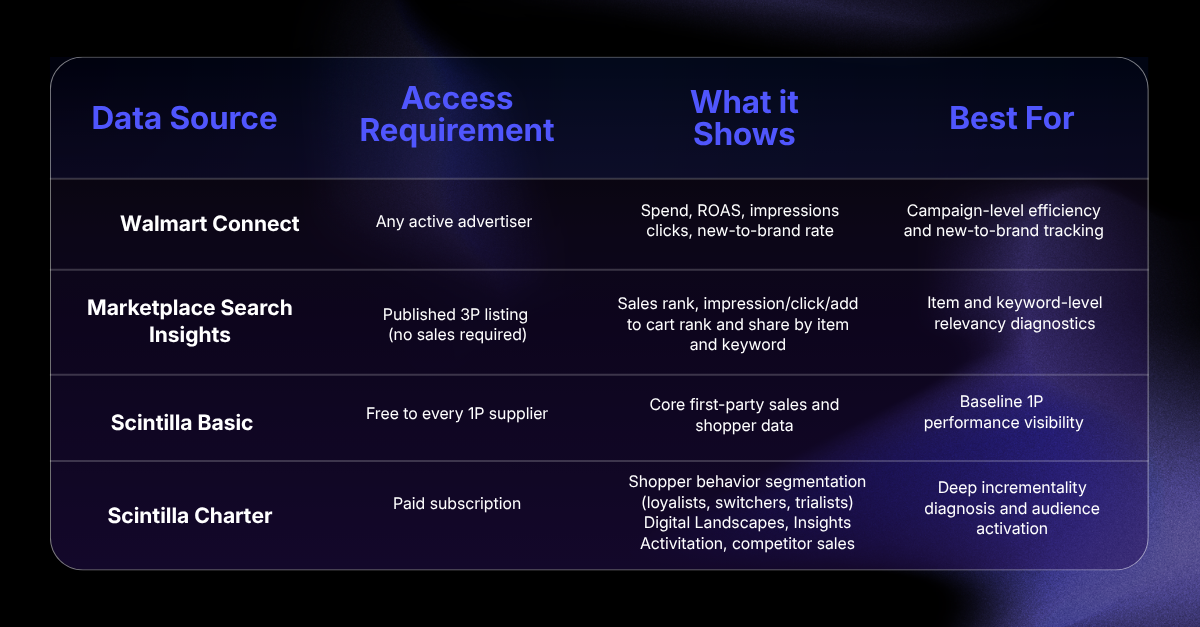
A detail many suppliers miss entirely: even a brand that only sells 1P can create a published, sales-free Walmart Marketplace listing purely to unlock Marketplace Search Insights, since this item and keyword-level data currently exists nowhere inside 1P reporting. For more on how Walmart Connect's advertising layer fits alongside this data, see our Walmart Connect DSS and DSP guide.
Do You Need Scintilla Charter to Start Measuring Incrementality?
If you are not on Charter, start with new-to-brand rate inside Walmart Connect. It is free, available today at the campaign and keyword level, and directionally tells you whether a campaign is reaching new demand or simply serving loyal reorderers. Our on-site display ads guide covers exactly where to find new-to-brand reporting inside your dashboard. If you do have Charter, the Shopper Behavior module is the most direct incrementality tool available, since it splits your buyer base into loyalists, switchers, and trialists, showing whether revenue growth is retention or genuine net-new demand.
What Changed in Walmart Incrementality Measurement for 2026
Walmart Connect's Search Incrementality feature, which isolates incremental sales specifically within Sponsored Search, has continued expanding to more managed advertisers through 2026, giving suppliers a clearer view of which search investments are creating demand versus capturing it. At CES 2026, Walmart Connect executives framed incrementality as a full-funnel measurement question rather than a single-campaign metric, tying awareness, search, and in-store media together through first-party transaction data. Suppliers should expect this full-funnel framing, plus continued rollout of AI-assisted Scintilla insights, to keep reshaping how incrementality gets reported through the rest of walmart 2026.
Common Walmart Incrementality Mistakes to Avoid
Treating content quality score as proof of relevancy. A near-perfect content score checks Walmart's compliance boxes but does not guarantee discoverability or conversion, since relevancy is driven primarily by actual conversion rate.
Targeting the broadest keyword first. Jumping straight to a category's biggest search term before proving conversion on a narrower term suppresses item-level relevancy across your entire catalog.
Reading Walmart Connect data in isolation. Walmart Connect shows what your advertising drove, not your total walmart ecommerce picture, so relying on it alone hides cannibalization and organic contribution.
Ignoring free Marketplace data because you sell 1P. Marketplace Search Insights is available the moment a listing is published, regardless of whether it has ever recorded a sale.
Letting teams work in silos. Scintilla and Walmart Connect data frequently sit with one team (often the store or content team) while the ecommerce and advertising teams never touch it, creating blind spots that show up as unexplained performance swings.
Frequently Asked Questions About Walmart Incrementality
What is incrementality in Walmart advertising?
Incrementality is the portion of sales an advertising campaign actually caused, separated from sales that would have happened anyway from loyal customers or brand-name searchers. It gives walmart marketplace sellers a truer read on whether ad spend is creating new demand or simply capturing existing demand.
What is Walmart Scintilla and how is it different from Walmart Connect?
Scintilla is Walmart's first-party shopper insights platform, covering purchase behavior, category penetration, and customer segmentation. Walmart Connect is the advertising platform itself, showing spend, ROAS, and campaign performance. The two are complementary, not interchangeable.
What is a good walmart new-to-brand rate benchmark?
There is no universal target, since it varies heavily by category and ad format, but sponsored video formats tend to produce the highest new-to-brand rates of any Walmart Connect format, making them a strong lever specifically for incremental reach.
Can I get Walmart Marketplace search data without Scintilla Charter?
Yes. Any published 3P listing, even one with zero sales, unlocks Marketplace Search Insights, giving you sales rank, impression rank, click rank, and add-to-cart rank at the item and keyword level, independent of any Scintilla subscription.
Does a high content quality score guarantee walmart relevancy?
No. Content quality score confirms your listing meets Walmart's compliance requirements, images present, copy fields filled, attribution complete, but relevancy is driven primarily by conversion rate, which content score does not measure directly.
The Bottom Line on Walmart Incrementality
Walmart incrementality is not a single metric to check once a quarter, it is a way of reading every layer of your walmart marketplace performance, from item-level relevancy to keyword laddering to full-funnel data, to see which dollars are actually building your business.
Suppliers who treat Walmart Connect, Marketplace Search Insights, and Scintilla as one connected system, rather than three separate dashboards, consistently find the clearest signal on where to invest next. For more guides like this one, visit SellCord's Walmart Marketplace resource center. If you want help turning your own Walmart data into a real incrementality read, SellCord's team works inside these exact data sources every day for over 500 brands.
Want expert help measuring your Walmart incrementality? SellCord's team of Walmart specialists can help you connect your Walmart Connect, Marketplace, and Scintilla data into one clear read on what is actually driving growth. 👉🏻 Explore SellCord's Dashna analytics platform.