

Shoppers used to type “sunscreen” and scroll through a full shelf of products. Now they ask Sparky for the best sunscreen for kids with sensitive skin, ask a follow-up, and choose from the products it suggests. Walmart Sparky share of voice measures how often Sparky recommends you vs. your competitors in those answers.
Sparky typically surfaces a short list of products for each question. If your listing can’t hold up its end of that conversation, it can get skipped. The good news: your listing content is in your control.
This guide covers what Sparky share of voice is, why it matters for Walmart Marketplace brands, and how to measure it, find what’s keeping your products out of the answer, and fix it. For the bigger picture, start with our guide to Walmart agentic commerce and Sparky.
What Is Walmart Sparky Share of Voice?
Sparky share of voice is how often Sparky recommends your products vs. your competitors when shoppers ask it questions. Sparky typically surfaces a short list, so share of voice shows whether your brand is part of the answer or left out of the decision.
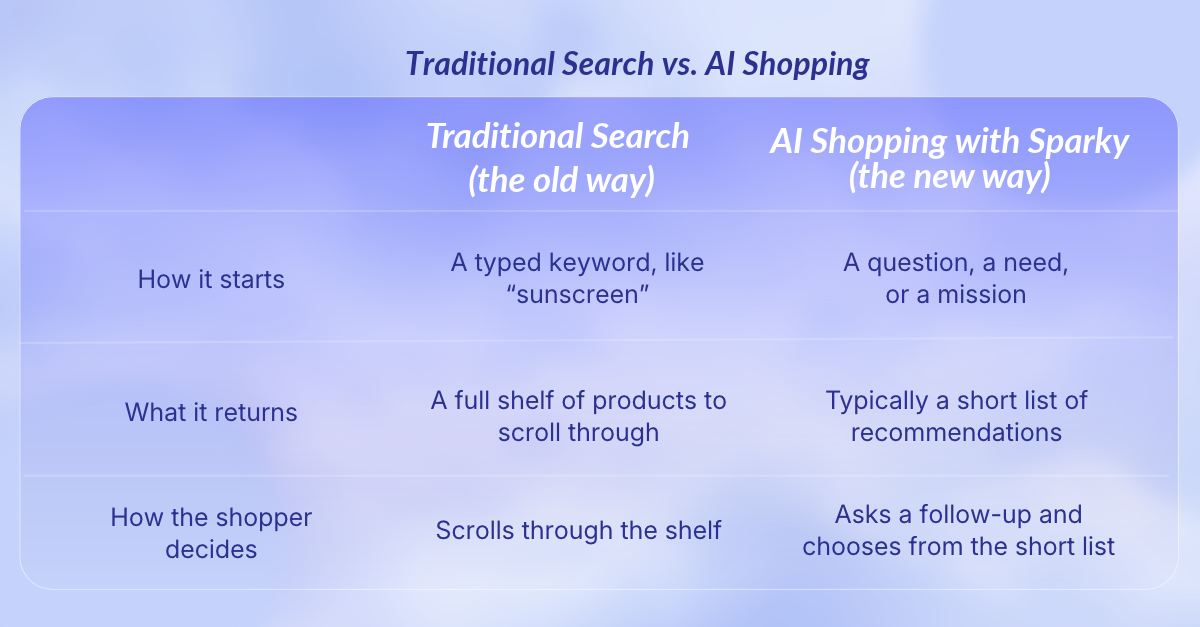
Sparky is Walmart’s AI shopping assistant. Shoppers ask it questions and it suggests products. With Sparky, shopping starts with a question, a need, or a mission, and typically ends with a short list of recommendations. Traditional search returns a full shelf of products to scroll through. The goal is for your Walmart product listing to be on that list.
Share of voice is measured with the right questions, the ones your shoppers actually ask. It is tracked against your own baseline and against the brands you compete with.
Why Does Visibility in Sparky Matter for Walmart Sellers?
Search is turning into a conversation. For a Walmart seller, that means shoppers often choose from a short list instead of scrolling a full shelf. Listings built for keyword search don’t always translate to conversational answers.
Not tracking visibility in Sparky has two consequences:
- Your listing can get skipped. If it can’t hold up its end of the shopper’s conversation, it may not make the short list.
- Competitors get picked instead. When Sparky recommends other brands, brands that aren’t included risk being left out of the decision.
Measuring visibility in Sparky belongs in any Walmart 2026 plan. For how it fits alongside search optimization, see our breakdown of Walmart SEO, GEO, and AEO strategies.
Traditional Search vs. AI Shopping
How to Measure and Improve Your Sparky Recommendations: Step-by-Step
The process has three stages:
- Measure where you stand.
- Know why you win or lose.
- Optimize your listings and track the results.
The six steps below follow that order.
1. Use the Shopper Questions Your Buyers Actually Ask
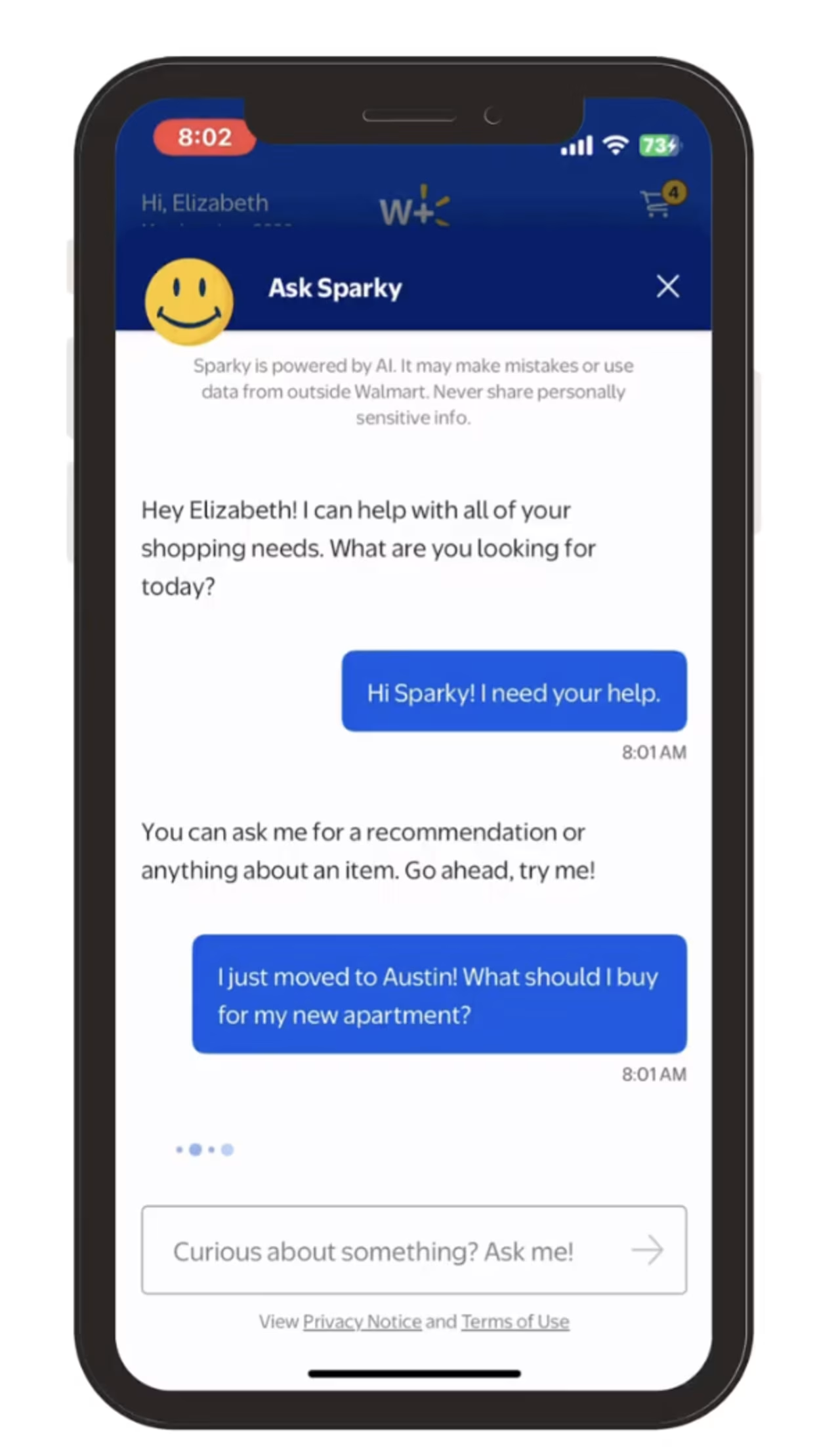
Measurement starts with the right questions: the ones your shoppers actually ask. With Sparky, shopping starts with a question, a need, or a mission, like the best sunscreen for kids with sensitive skin. Shoppers ask follow-ups before they choose from the short list.
SellCord builds a set of shopper questions for each product.
2. Set Your Baseline: How Often Your Products Show Up Today
Your baseline is how often your products show up in Sparky today. Every change you make later is measured against it.
Dashna tracks how often your products show up in Sparky’s recommendations over time, at the product level. Each item is labeled as strong, improving, needs attention, or critical gap.
3. Benchmark How Often Sparky Recommends You vs. Competitors
Next, compare your visibility with the brands you compete with. This is your share of voice: how often Sparky recommends you vs. competitors.
The Dashna GEO Optimizer performance overview shows your recommendation share of voice and your share of recommendations against each competitor.
4. Find What May Be Keeping Products Out of Sparky’s Answers
Start with who’s winning: the competitors Sparky picks instead of you. Then review the listing gaps that can keep your products out of the answer:
- Missing attributes
- Weak content
- Unclear claims
Finish with clear priorities: the products and fixes that matter most.
5. Fix Listing Gaps With Accurate, Walmart-Compliant Content
Fix the listings, starting with your priorities. Every update should be accurate, Walmart-compliant content. Make sure every change you submit in Walmart Seller Center goes live.
For more on completing attributes, see our guide to the Walmart Content Quality Score and Item Spec 5.0.
6. Measure the Change and Scale What Works
Measure the change by comparing results against your baseline. Dashna’s pre and post inclusion view shows how a product’s inclusion moves after the fix. Then scale what works by rolling it out across more products.
Why SellCord: Our Own Data and Our Own Tech
Other GEO (generative engine optimization) tools guess. SellCord uses its own data.
Dashna GEO Optimizer is a done-for-you service: SellCord shows you where you stand in Sparky, then SellCord’s team fixes your listings and tracks the results. It is not part of a standard content package. Listings built for keyword search don’t always translate to conversational answers, so this is its own program with its own measurement.
- Walmart-only: years of data from SellCord’s work with Walmart sellers behind every fix SellCord makes.
- Catalog experts: SellCord knows what gets products found on Walmart, and what holds them back.
- Our own tech: Dashna powers the measurement and the fixes.
- Built to scale: from a few hero items to thousands of SKUs.
- We prove it: one team finds the gaps, fixes them, and shows you what changed.
Sparky is the main focus. SellCord also optimizes and tracks your visibility in ChatGPT, Gemini , Google AI Overviews, Perplexity, and Claude.
Common Sparky Visibility Mistakes to Avoid
Each of these skips a step in the measure, analyze, optimize process.
Testing with generic questions. Use the questions your shoppers actually ask, not only a single keyword like “sunscreen.”
Relying on traditional search signals. Listings built for keyword search don’t always translate to conversational answers. Measure Sparky visibility on its own instead of relying on search results or Walmart Buy Box status.
Changing listings without a baseline. Results are measured against your baseline, so set it first.
Skipping priorities. Start with the products and fixes that matter most.
Not confirming changes went live. Every Walmart third party seller should check that each change goes live on Walmart.com. Where weak content is the gap, see our guide to Walmart rich media for AI search.
Frequently Asked Questions About Sparky Share of Voice
What is Sparky?
Sparky is Walmart’s AI shopping assistant. Shoppers ask it questions and it suggests products. With Sparky, shopping starts with a question, a need, or a mission, and Sparky typically surfaces a short list of recommendations instead of a full shelf. Shoppers can ask a follow-up before choosing from that list. Brands that aren’t included risk being left out of the decision.
How do you measure Sparky visibility?
For a Walmart marketplace seller, measurement starts with a set of shopper questions for each product: the ones your shoppers actually ask. Dashna tracks how often your products show up in Sparky’s recommendations over time, which sets your baseline. From there, a competitive benchmark shows your visibility vs. the brands you compete with. Results after any fix are measured against that baseline.
What does GEO mean?
GEO stands for generative engine optimization: making your products easy for AI to find, understand, and recommend. It has nothing to do with geography. For Walmart brands, Sparky is the main focus. SellCord also optimizes and tracks visibility in ChatGPT, Gemini, Google AI Overviews, Perplexity, and Claude, using Dashna to power both the measurement and the fixes.
How is Sparky different from traditional Walmart search?
Shoppers used to type a keyword like “sunscreen,” and traditional search returned a full shelf of products to scroll through. With Sparky, shopping starts with a question, a need, or a mission, and Sparky typically surfaces a short list. Listings built for keyword search don’t always translate to conversational answers. Brands that aren’t included in that short list risk being left out of the decision.
Why do Walmart products get left out of Sparky’s answers?
Listing gaps can keep products out of the answer: missing attributes, weak content, and unclear claims. If a listing can’t hold up its end of the shopper’s conversation, it can get skipped. The fix starts with knowing who’s winning, meaning the competitors Sparky picks instead of you, and setting clear priorities. Then the listings are updated with accurate, Walmart-compliant content, and every change is checked to make sure it goes live.
Conclusion
Search is turning into a conversation, and Sparky typically answers with a short list. Walmart Sparky share of voice shows whether your brand is part of the answer or left out of the decision.
The path to more Sparky recommendations has three stages: measure your share of voice, know why you win or lose, and optimize your listings while tracking the results. For any Walmart ecommerce brand, the good news holds: your listing content is in your control. For more strategies, explore SellCord’s Walmart Marketplace blog.
Want expert help improving your visibility in Sparky? SellCord’s team will show you where you stand in Sparky, fix your listings, and track the results. Get your Sparky audit with Dashna GEO Optimizer.