
Most sellers walk into Q4 with one plan: spend more on ads. Then bids climb, budgets cap out early, and the top spots still go to someone else. A winning Walmart holiday advertising strategy starts somewhere less obvious, with the listing itself. On Walmart Marketplace, relevancy decides where your product shows up and how much each click costs, so the sellers who win the holidays usually fix their catalog before they raise a single bid.
The holiday season now runs from October through the end of December, which still leaves time to get the order right. This guide covers why relevancy beats bid size, which ad tools to use this season, eight steps to build your Q4 plan, and the mistakes that quietly drain holiday budgets.
What Is a Walmart Holiday Advertising Strategy?
A Walmart holiday ad plan is a seasonal framework for how a brand uses its listings, Walmart Connect ads, and promotions to capture shopper demand from October through December. It sets the order of work: listing architecture first, then content, then media, then promotions, so each layer makes the next one cheaper and more effective.
The order matters because each layer builds on the one below it. Listing architecture and content earn relevancy, which is your right to appear when a shopper searches for something you sell. Strong relevancy makes media run more efficiently, media builds visibility, and promotions turn that visibility into conversion. If you need a refresher on the foundation, our breakdown of the walmart listing quality score and Item Spec 5.0 covers the scoring framework in detail.
The plan also covers a full season, not a single event. Holiday shopping on Walmart.com kicks off with the October deals event and runs through Black Friday, Cyber Monday, and Christmas. Shoppers research and return several times across that window, so every search is another chance to win the basket.
Why Do Walmart Connect Ads Matter More for Walmart Sellers in Q4?
Q4 is the Super Bowl of Walmart ecommerce, and the extra traffic arrives ready to buy. Searches for ornaments and holiday lights accelerate, but shoppers keep adding everyday essentials to the same cart, so even a brand with no giftable items has a real Q4 opportunity.
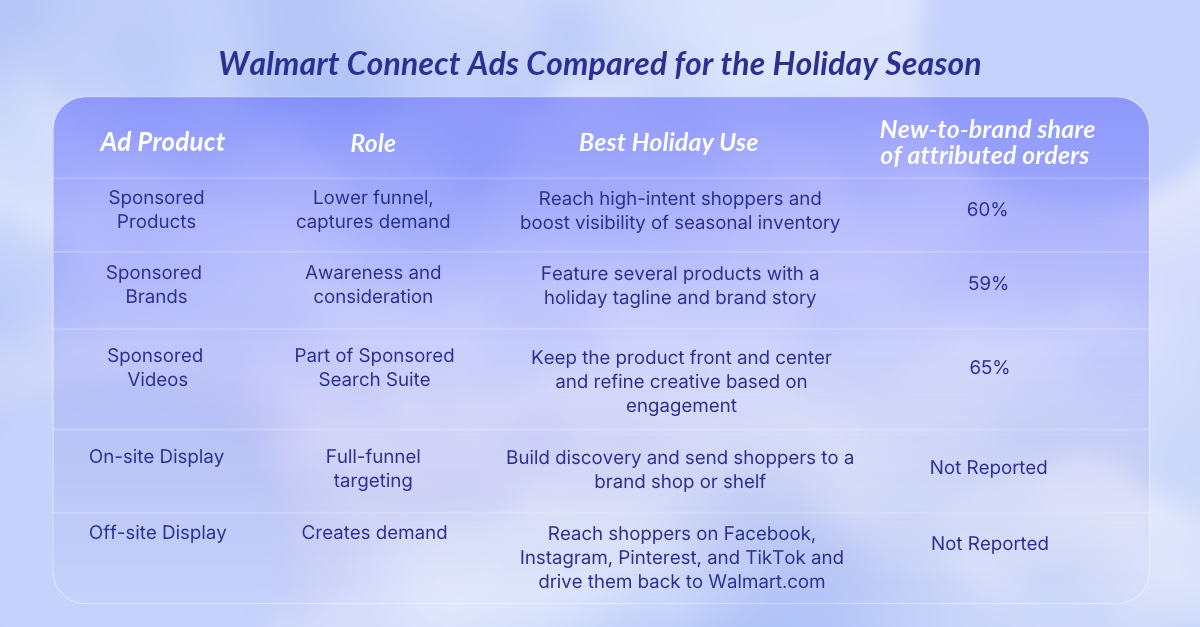
Ads are also one of the best ways to reach new customers right now. Walmart Connect data shows that 60% of Sponsored Products attributed orders, 59% of Sponsored Brands attributed orders, and 65% of Sponsored Videos attributed orders come from new-to-brand buyers. A new-to-brand sale is incremental by nature: it is a sale you were unlikely to get otherwise.
Skipping a plan costs you in three ways. Weak relevancy forces you to bid higher just to compete, so every click costs more. Items that lose the Walmart buy box or run low on stock underdeliver at the exact moment traffic peaks. And late launches miss the relevancy-building window, which is why strong holiday campaigns start weeks before Black Friday and Cyber Monday
Relevancy Beats Bigger Bids in Walmart Keyword Bidding
Walmart runs a second-price auction, and the highest bid does not automatically win. Picture two sellers bidding on “water bottle”: one bids $1, the other bids $3. Walmart weighs each bid alongside customer experience factors such as shipping speed and, above all, how relevant each item is to the search. The $1 bid can win because Walmart judges that listing the better fit. You can flood bids to offset weak relevancy, but you cannot buy your way to the top.
Relevancy is built mostly where sellers rarely look. In SellCord’s experience, roughly 40% of what gets a listing indexed sits on the back end: product type, category path, digital shelf, and attributes. Copy accounts for about 45%, and images and video for about 15%. Aim for a Listing Quality Score (Content Quality Score for 1P items) of 95% or higher, but remember that the score measures compliance and completeness. It does not guarantee visibility. Relevancy does.
New and Underused Ad Tools for This Holiday Season
The Walmart 2026 holiday season gives advertisers three tools worth building into the plan.
Negative keywords for automatic campaigns. Negative keywords are now available for automatic Sponsored Products campaigns, so you can remove keywords that spend inefficiently in real time, during the busiest weeks of the year.
Objective-based display optimization. On-site display campaigns can optimize toward a chosen objective (awareness, engagement, or conversion) using Walmart Connect’s AI, which reduces mid-flight adjustments.
Wider off-site reach. Off-site display reaches shoppers on Facebook, Instagram, Pinterest, and TikTok and drives them back to Walmart product pages.
Eight Steps to Build a Q4 Plan for Walmart Sponsored Products and Display Ads
1. Audit the Taxonomy of Your Top 20% of SKUs
Start with the catalog, not the campaign. Apply the 80/20 rule: identify the top 20% of SKUs that drive most of your revenue and confirm each one sits on the right digital shelf. For each priority item, check:
- Product type: matches what the item actually is
- Category path: places the item where shoppers browse for it
- Attributes: complete and accurate, with variants correctly aligned to the main item
- Stock and price: in stock, with your best available offer
Walmart is an everyday low price destination, so never give a shopper a reason to check another site. Check item health in Walmart Seller Center before you touch a single ad setting.
2. Make Every Walmart Product Listing Holiday Ready
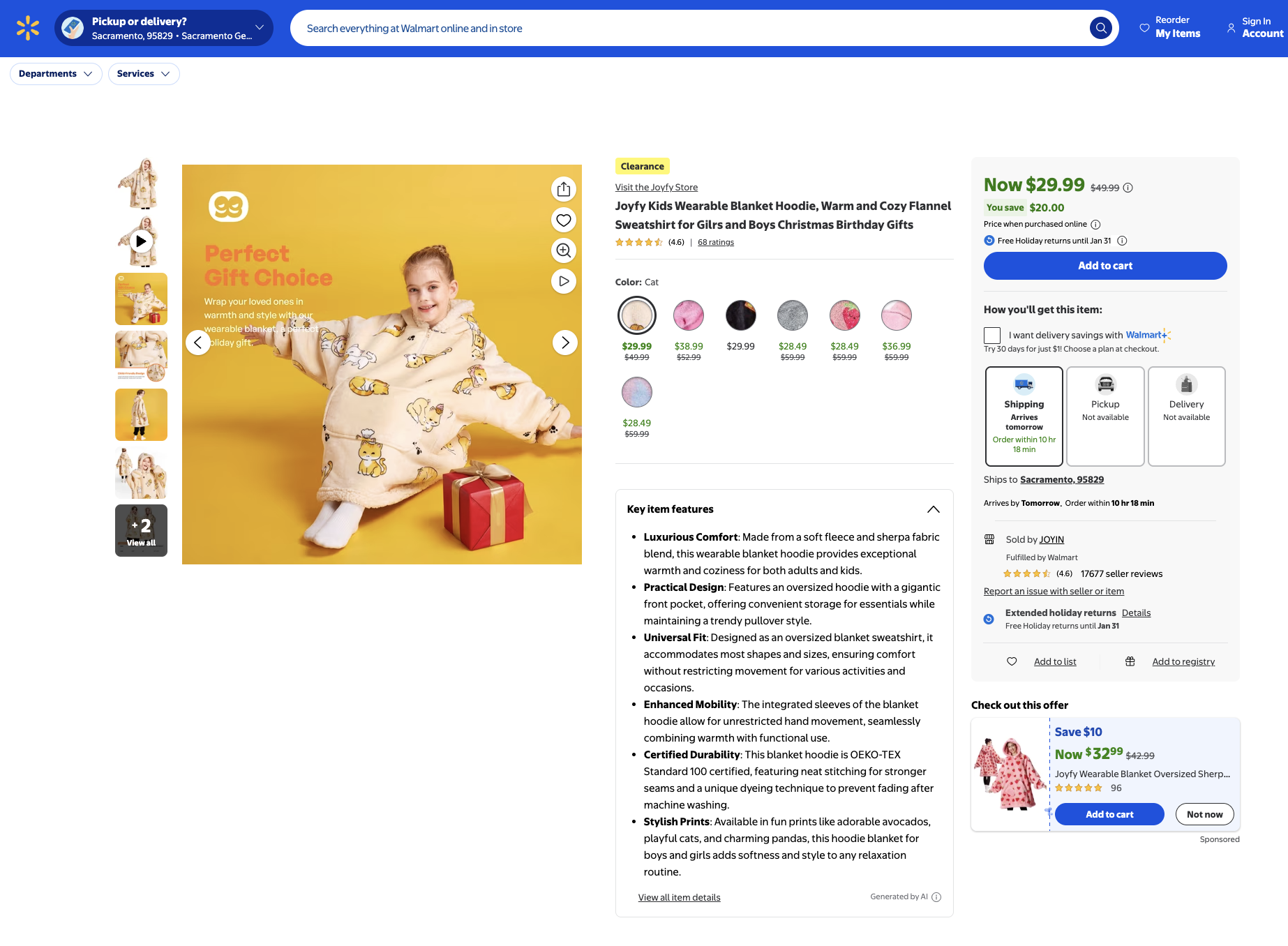
Put your most important keywords in the title, write rich descriptions, and work in seasonal language naturally: gifting, entertaining, family moments, and holiday occasions. Generic copy with “Christmas” dropped in helps no one. Skip image decks that show the same item from three angles. Use lifestyle images that show the product in use, and apply one test: a shopper should be able to decide from your images alone. Holiday creative should also reflect how Walmart customers shop:
- Lead with value: 80% of Walmart customers prioritize price when buying gifts
- Show family moments: nearly half plan to host gatherings of five or more people
- Inspire baskets: 89% plan to shop Walmart for hosting and attending parties
3. Get Rich Media Live Before Peak Traffic
Rich media turns the product page into a richer experience that educates shoppers and moves a click toward a purchase. Above the fold, prioritize two modules:
- Video with a thumbnail, so shoppers see the product in action
- 360 spin, which replaces several angle shots with one interactive image
Below the fold, use feature sets, before-and-after modules, and comparison tables, which help shoppers pick the right version and explore the rest of your line. These modules also give Walmart’s personalization engine and its AI assistant, Sparky, more data to work with. Our guide to the rich media modules that feed Sparky shows which ones carry the most weight.

4. Prioritize the Search Terms That Drive 80% of Revenue
SellCord’s data shows that a typical product has about 100 search terms that can generate revenue, but the top 15 to 20% of those terms usually drive 80% of it. Get bids and budgets right on those terms first, then expand to capture a wider audience. Build your list from four sources:
- Performance reports that reveal high-performing keywords and untapped impressions
- Seasonal keyword insights from the Walmart Connect Partner Network newsletter
- The exact language customers use in your reviews
- Competitor product names, added as long-tail keywords
During Q4, add gifting terms, which become far more relevant as the holidays get closer.
5. Balance Automatic and Manual Sponsored Products Campaigns
Sponsored Products match ads to shopper queries in real time, and you pay only per click. Balance automatic and manual campaigns. Automatic campaigns enable rapid scaling, and seasonal campaigns should carry stronger bids on keywords you know are highly seasonal. Use negative keywords to remove inefficient keywords from automatic campaigns. Our guide to running walmart auto and manual campaigns explains how to move winning terms from one into the other.
For Sponsored Brands, test branded and non-branded keywords across match types. For Sponsored Videos, keep the product front and center and refine creative based on engagement.
6. Layer Walmart Display Ads for Sellers Across the Full Funnel
Search captures demand, and display creates it. Walmart Connect data shows that brands combining search and display in a full-funnel strategy saw three times more orders than brands that did not. Sponsored Brands, Sponsored Videos, and on-site display are open to first-party suppliers and to any Walmart third party seller with a registered brand. Match each on-site display objective to the shopper’s stage:
- Awareness: broad reach and eye-catching holiday creative, sent to a brand shop or shelf
- Engagement: audiences and keywords that signal interest, paired with clear product benefits
- Conversion: high-intent audiences, strong reasons to buy now, and the shortest path to purchase
Online ads also reach the store: 40% of surveyed Walmart customers say they are likely to buy in-store after seeing a product advertised on Walmart’s site or app. That is why full-funnel holiday campaigns should connect every touchpoint of the shopper journey.
7. Raise Budgets and Rethink Walmart ROAS Targets
Holiday demand spikes, so a flat budget leaves sales on the table. SellCord’s benchmark is a Q4 budget increase of at least 25 to 35%, scaled into the peaks of shopper intent.
Then watch conversion. A listing that converts 10% of visitors most of the year may convert 15 to 20% during the holidays, because shoppers decide faster. When that happens, consider softening your ROAS target: you can bid more, win more auctions, and still earn a strong return.
Pair ads with promotions. Join Black Friday, Cyber Monday, and other deal events, show the strikethrough price, and aim for a 10 to 30% discount. If you miss an event slot, run the deal anyway.
8. Monitor Pacing and Fix Underdelivery Fast
Even the strongest setup needs attention during the season:
- If you’re underpacing: check item health, confirm you hold the Walmart buy box, keep bids competitive, and expand match types
- If you’re underperforming: use performance reports to find what works and shift bids toward efficient items and keywords
- If you’re capping out: increase budget so campaigns stay live during peak hours
- For on-site display: read the pacing indicator alongside the win rate in the bid performance report before changing bids, budgets, targeting, or frequency caps
Make small changes, measure, and adjust again. Keep campaigns active through Black Friday, Cyber Monday, and beyond, because the holidays are a marathon.
Common Walmart Holiday Advertising Mistakes to Avoid
Raising bids before fixing relevancy. Weak taxonomy and attributes make every click more expensive, which is why understanding how the Walmart ad auction works matters before you scale spend.
Treating a 95% quality score as the finish line. The score confirms your listing is complete, not that it is relevant to the searches you want to win.
Running Sponsored Products alone. Skipping Sponsored Brands, Walmart video ads, and display means you only meet shoppers at the last step of their journey.
Launching the week of Black Friday. Campaigns need weeks of history to build relevancy, so a late start misses the window to build it.
Sitting out because you have no giftable products. Holiday shoppers still buy everyday essentials, and that intent is open to any Walmart Connect advertiser.
Frequently Asked Questions About Walmart Holiday Advertising
When should Walmart sellers start holiday advertising?
Start in October. Holiday shopping kicks off with the October deals event and runs through December, and strong campaigns launch weeks before Black Friday and Cyber Monday to build relevancy early. If you are already late, start now. Shoppers research and return to Walmart multiple times across the season, so there is still room to win sales.
How much should I increase my Walmart ad budget for the holidays?
SellCord’s benchmark is an increase of at least 25 to 35% over your normal budget. Scale spend into the peaks of shopper intent, such as Black Friday and Cyber Monday, and stay efficient between them. Watch for budget cap-outs, and increase spend if a campaign is capping out. More spend should follow demand, not replace optimization.
Why are my Walmart ads not spending?
When campaigns underpace, start with the item. Check item health, confirm the item holds the buy box and is in stock, and make sure bids are competitive for the season. If those look fine, expand match types to reach more searches. Weak relevancy also limits delivery, so confirm the product type, category path, and attributes are correct before you raise bids.
Does a higher bid guarantee top placement on Walmart?
No. Walmart runs a second-price auction that weighs your bid alongside customer experience factors such as shipping speed and, most importantly, item relevancy. A lower bid can win if Walmart judges that listing a better fit for the search. You can raise bids to try to offset weak relevancy, but Walmart will always favor the result that gives the customer the best experience. Strong listing architecture lowers your cost and improves placement at the same time.
Do I need giftable products to advertise on Walmart during the holidays?
No. Holiday traffic on Walmart arrives with intent to buy, and shoppers keep adding everyday essentials like eggs and paper towels to the same cart while they shop for gifts. Searches for seasonal items like ornaments and lights accelerate, but demand for essentials doesn’t stop. Brands without seasonal or giftable products can still win by bidding on the terms shoppers use and making listings relevant to the season.
Conclusion
Holiday advertising on Walmart rewards order, not just spend. Fix the taxonomy of your top SKUs, make listings and rich media holiday ready, focus bids on the terms that drive most of your revenue, and layer display on top of search. Then raise budgets with demand and let higher conversion rates justify more aggressive bidding. A relevancy-first Walmart holiday advertising strategy lowers your cost per click and lifts your placements at the same time. For more playbooks, browse our Walmart marketplace seller guides.
Want expert help optimizing your Walmart holiday advertising? SellCord’s team of Walmart specialists is ready to help you build listing relevancy, scale your Walmart Connect campaigns, and turn Q4 traffic into profitable growth. Talk to our Walmart advertising management team.