
Getting approved is the easy part. The hard part starts the day your store goes live, when every tool, program, and dashboard in Seller Center seems to demand your attention at once. As a Walmart Marketplace new seller, you have limited time, limited budget, and no sales history, so the order in which you tackle things matters more than the number of things you tackle. Brands expanding from Amazon to Walmart Marketplace often feel this most, because habits that worked on another channel do not always translate. This guide lays out a phased 90-day plan built on Walmart's own Seller Success Formula and SellCord's experience launching brands on walmart.com, covering what to fix first, what to build next, and which popular tactics are safe to postpone.
What Should You Prioritize in Your First 90 Days on Walmart Marketplace?
In your first 90 days, prioritize the five levers Walmart itself grades you on: correct categorization, a listing quality score above 80, competitive pricing, fast and free shipping, and clean fulfillment metrics. Postpone promotions, display advertising, and in-store ambitions until your listings convert and your account qualifies for Pro Seller status.
That sequence mirrors the Seller Success Formula that Walmart's business development team walks new sellers through: assortment, listing quality, pricing, fulfillment, and discoverability. Each lever depends on the one before it. Ads cannot rescue a miscategorized item, and a strong offer cannot win the Walmart Buy Box if shipping is slow.
Why the First 90 Days Matter for Every Walmart Seller
Walmart builds its own milestones around the 90-day mark, which makes this window more than an arbitrary planning horizon. Three things are on the clock from the day you start selling.
First, cash flow. Under Walmart's new seller payment hold policy, a portion of your payouts is held on a rolling delay until 90 days have passed since your first shipped order and you have received $7,500 in payments. The exact timeframe varies by country of incorporation, so plan inventory and ad spend around delayed revenue.
Second, status. Pro Seller eligibility requires at least 90 active days and more than 100 orders in the past 90 days. Every late shipment or cancellation you log now counts against the metrics Walmart evaluates later.
Third, momentum. Walmart's algorithm rewards conversion, not just volume. The impressions, clicks, and purchases your listings earn in the first weeks become the performance history that shapes future ranking.
What's Different for New Sellers in 2026
The Walmart 2026 New-Seller Savings program runs from February 2, 2026 to January 31, 2027, and applies to sellers who go live after February 1, 2026. Walmart has also added a price competitiveness score to its Pro Seller tiers, and Item Spec now organizes attributes by specific product type rather than broad categories.
Your 90-Day Walmart Launch Plan: Step-by-Step
1. Claim Walmart New-Seller Savings 2026 and Secure Your Seller Center Account (Week One)
Start with money you would otherwise leave on the table. Walmart's New-Seller Savings 2026 offers up to $75,000 in combined value. That includes referral fee discounts of 20% on your first $50,000 in GMV, 30% between $50,000 and $500,000, and 40% above that. The package also includes up to $2,000 in WFS credits, up to $1,000 in Search Engine Marketing credits, and up to $500 in Walmart Connect ad credits. Walmart's program FAQ directs sellers to opt in from the payments page after going live, so confirm your enrollment in Walmart Seller Center during week one.
While you are there, follow Walmart's own first 30 days checklist: add team members with the right permission levels, keep your contact list current, and turn on two-step verification.
2. Fix Categorization Before You Chase Traffic (Days 1 to 30)
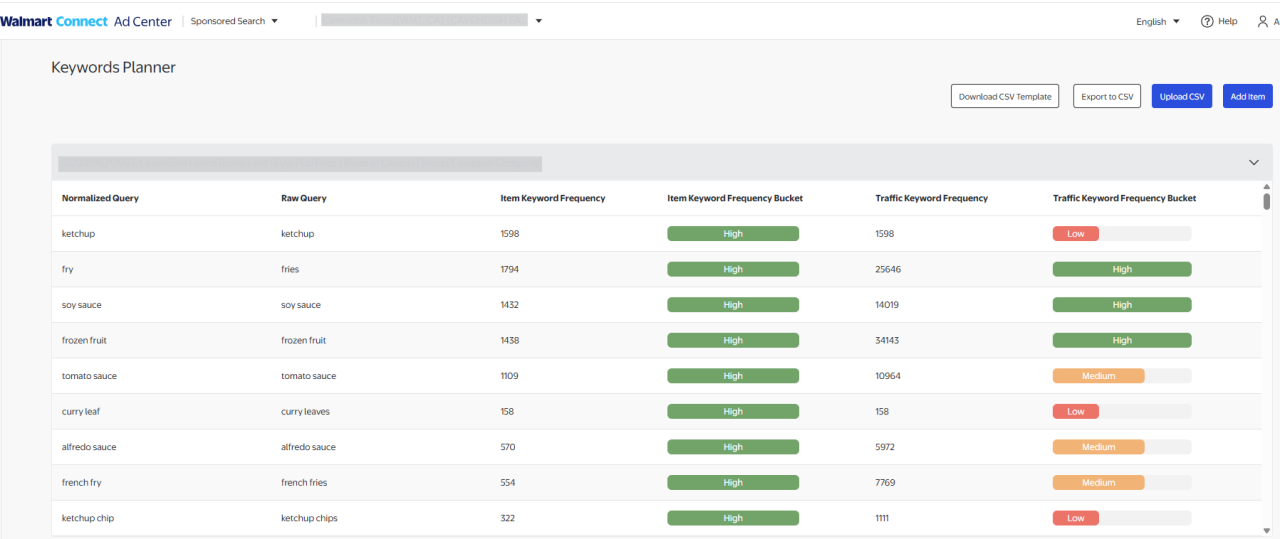
Categorization is typically the most impactful piece of your setup. Search your top keyword on walmart.com, study the leading listings, and match their product type and category path. Then confirm your main keywords appear in the title.
Getting this wrong quietly caps your reach. Product type also determines which attributes you can fill in, so a wrong classification can hide the exact specs shoppers filter by. Our guide to Walmart category placement and product type goes deeper on choosing the right path.
3. Push Your Walmart Listing Quality Score Above 80 (Days 1 to 30)
Your listing quality score is Walmart's scorecard for whether an item deserves to be indexed and shown. It weighs content and discoverability, the competitiveness of your offer, ratings and reviews, and post-purchase quality. A score below 80 keeps a listing out of contention for meaningful traffic.
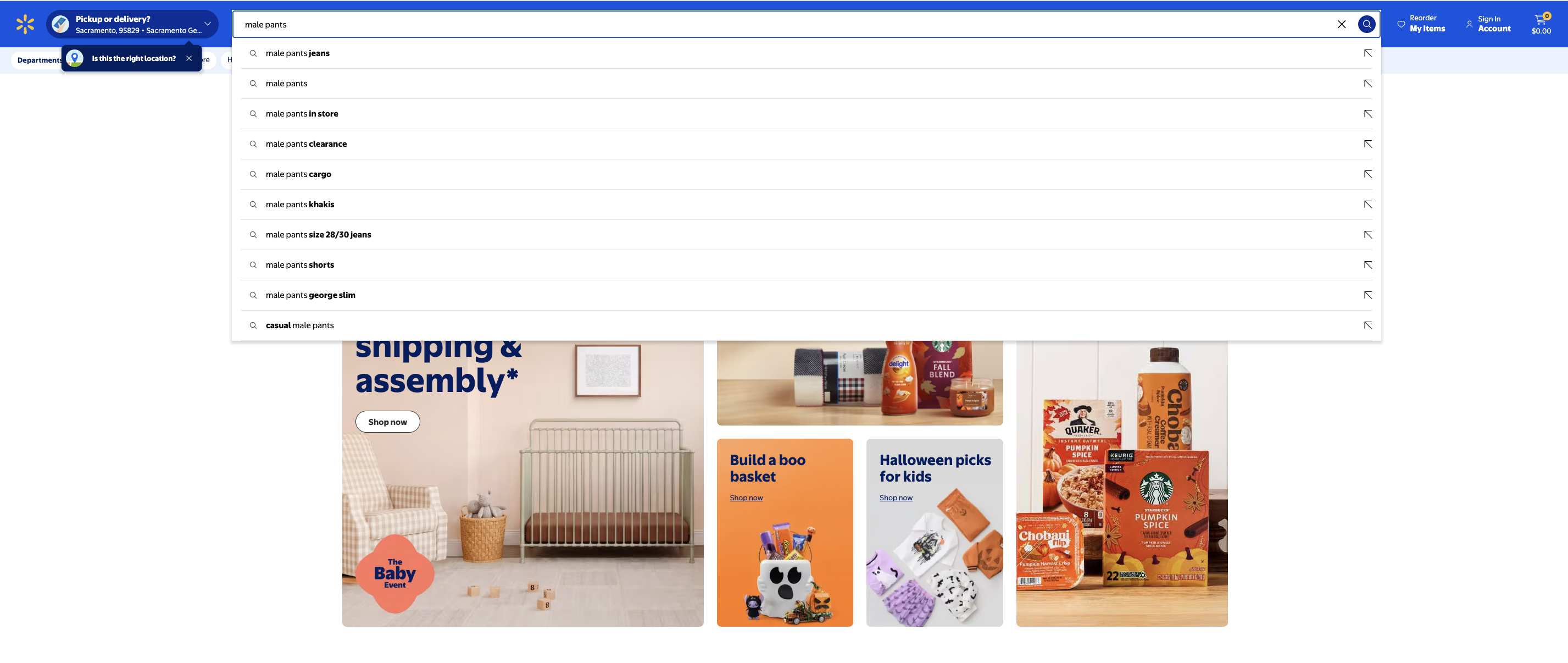
Every Walmart product listing should include keyword-rich titles, complete attributes, and high-quality images. Use Walmart's naming conventions, not your own. Walmart uses "male" and "female" rather than "men" and "women," and color values may be spelled differently than on other channels. The GenAI content tool inside Seller Center can speed up compliant, SEO-friendly copy across a large catalog.
4. Price to Win the Walmart Buy Box With Repricer (Days 1 to 30)
Shoppers cross-shop on their phones, so your price has to hold up across every channel. Walmart's Pricing Insights dashboard shows your Buy Box win rate over the trailing seven days, along with recommendations to improve it.
Repricer is a free Seller Center tool that adjusts prices automatically inside the floor and ceiling you set, which protects your margin while keeping offers competitive. You can apply it to select items only. Walmart's business development team calls Repricer one of the few levers that can lift sales the same day you switch it on. Price also feeds your listing quality score, since the competitive offer component weighs price alongside delivery speed and in-stock status.
5. Commit to Fast, Free Shipping Through Walmart Fulfillment Services or Your Own Network (Days 1 to 30)
Shoppers expect fast delivery, and Walmart rewards sellers who deliver on that promise. You can meet it with your own logistics network or with Walmart Fulfillment Services, which stores, picks, packs, and ships for you with no inventory minimums.
Walmart reports that WFS sellers see 50% GMV growth, on average, for items carrying the "Fulfilled by Walmart" tag and two-day delivery promises, based on its first-party data. David Milstein frames WFS as a tool that has moved from optional to advantage, and will likely become a necessity. Setting up the integration now, while the $2,000 credit offsets fees, puts you ahead of that curve.
6. Solve the Cold Start With Reviews (Days 31 to 60)
A new item with zero reviews struggles to convert, which in turn limits ranking. Walmart offers a way around that cold start. If you already collect reviews on your direct-to-consumer site, Walmart can import those reviews from trusted, verifiable sources to support your listing quality from launch. Walmart runs this through its Review Syndication Program, and because ratings and reviews are one of the four listing quality components, every early review does double duty.
From there, build a steady review pipeline so recent feedback keeps arriving. Our breakdown of Walmart review strategies covers compliant ways to build social proof without risking policy violations.
7. Launch Walmart Sponsored Products Once Listings Are Ready (Days 31 to 60)
Advertising amplifies what already works, so switch it on after categorization, content, price, and shipping are in place. Walmart's business development team suggests starting with an automatic campaign once your listing quality score reaches 80, because the search-term data shows which queries shoppers actually use to find you.
Expect early return on ad spend to look soft for the first one to two weeks while attribution settles, and avoid major changes during that period. Check the advertising dashboard for budgets that run dry by early afternoon when your category traffic peaks later in the day. For the fundamentals, see our guide to Walmart Sponsored Products for beginners.
8. Protect Your Metrics and Qualify for Walmart Pro Seller Status (Days 61 to 90)
By now your account is approaching the 90-day activity requirement. The Walmart Pro Seller program sets tiered thresholds. Pro Seller status requires an on-time delivery rate of at least 95%, a cancellation rate of 1.5% or less, a seller responsiveness rate of at least 95%, and minimum shipping speed, content quality, and price competitiveness scores. Walmart reports that Pro Sellers have 1.7 times the conversion of the average Walmart marketplace seller.
This is also the right moment to widen your catalog. The Assortment Growth dashboard suggests in-demand items you are not yet selling, and a broader assortment creates a halo effect across your listings.
What to Skip Until Your Foundation Is Set
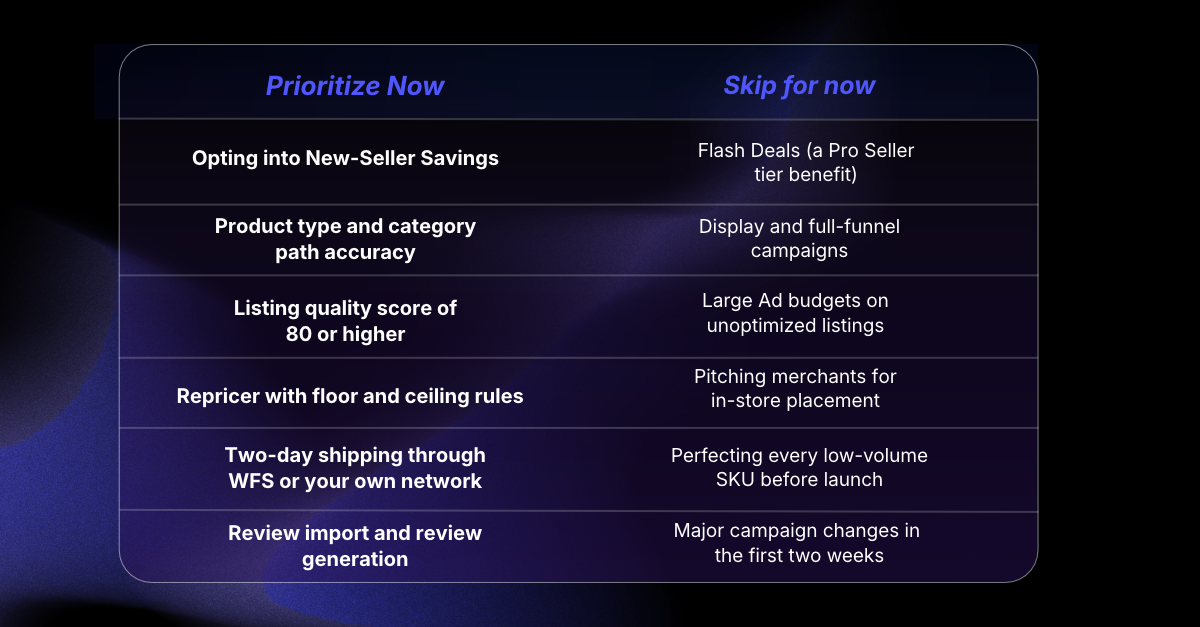
Some tactics are valuable later and expensive now. Skip chasing Flash Deals, since Walmart lists access to them as a Pro Seller tier benefit. Hold off on display and full-funnel campaigns until sponsored products prove which keywords convert. Reusing proven keywords gives later campaigns a stronger intent signal. Skip polishing every long-tail SKU before launch: bring a broad assortment, but concentrate optimization on the items most likely to sell. And postpone merchant conversations about store shelves. Marketplace sales data becomes a strong pitch later, but only once you have months of clean performance to show.
Common Walmart Marketplace Launch Mistakes to Avoid
Missing the New-Seller Savings opt-in. Discounts on referral fees only help if your enrollment is confirmed, so check the payments page in week one.
Assuming a good score guarantees visibility. A strong listing quality score makes an item eligible to rank, but taxonomy and query performance decide whether shoppers actually find it.
Copying Amazon listings as-is. Attribute names and values differ on Walmart, and mismatches break the connection between search queries and your item.
Making major ad changes too early. Reacting to the first week of data resets learning before attribution settles.
Pooling every ad group into one budget. Separate budgets show which segments win and keep strong audiences from being starved of spend.
Treating in-store placement as a launch goal. Moving from Walmart third-party seller to 1P supplier or store shelves is a real path, but it depends on proven sell-through first. Our comparison of Walmart 1P vs. 3P selling models explains when each makes sense.
Frequently Asked Questions About Being a Walmart Marketplace New Seller
How long does Walmart hold payments for new sellers?
Walmart applies a rolling payment hold to all new marketplace sellers, starting on the day of the first shipped order. A portion of each payout is delayed until 90 days have passed since that first shipment and the seller has received $7,500 in payments. The exact timeframe varies by country of incorporation. Plan inventory purchases and early ad spend with this delay in mind so cash flow does not stall your launch.
How long does it take to become a Walmart Pro Seller?
At minimum, 90 days. Walmart requires sellers to be active for at least 90 days and to have more than 100 orders in the past 90 days before earning any tier. Beyond that, you must meet thresholds for on-time delivery, cancellations, responsiveness, shipping speed, content quality, and price competitiveness. Walmart refreshes status on the 5th and 20th of each month, so clean metrics from day one shorten the path.
When should a new Walmart seller start advertising?
Start once your listings are correctly categorized, your listing quality score is at 80 or higher, and your price and shipping are competitive. Advertising sends traffic to a page, so it only pays off if that page converts. An automatic sponsored products campaign is a practical first step because it reveals the search terms shoppers use. Expect soft results in the first one to two weeks while data accumulates.
Should new sellers use Walmart Fulfillment Services?
For most brands, yes. WFS handles storage, picking, packing, shipping, and returns for WFS orders, with no inventory minimums or maximums. It helps you offer two-day delivery, which Walmart ties to stronger visibility and conversion, and it supports several Pro Seller metrics. New-Seller Savings 2026 adds up to $2,000 in WFS credits. Sellers with a strong fulfillment network can still succeed with seller-fulfilled shipping.
How do new sellers get reviews on Walmart?
If you already collect reviews on your own website, Walmart can import them from trusted, verifiable sources so new listings do not launch with zero social proof. After that, focus on compliant review generation and consistent post-purchase quality, since accurate listings and on-time delivery drive positive feedback. Walmart also offers Post-Purchase Reviews, and Advanced and Pro Sellers receive a credit toward that program.
Conclusion
In Walmart ecommerce, your first 90 days reward sequence over speed. Fix categorization and content first, compete on price and shipping, then add reviews and advertising once your listings are ready to convert. Treat Pro Seller status as the finish line for this phase, and leave promotions, display campaigns, and store ambitions for the months that follow. Every Walmart Marketplace new seller who follows this order builds a foundation that makes each later dollar work harder. For more playbooks, explore the SellCord Walmart Marketplace blog.
Want expert help launching on Walmart Marketplace? SellCord's team of Walmart specialists is ready to help you set up, optimize, and launch your catalog so you reach Pro Seller status faster. Explore our 👉🏻 Walmart seller onboarding services and start your first 90 days with a proven plan!